What This Giant Harvard Study Has To Tell Us About Dungeons & Dragons For Kids
The Flourishing Schools Project is a part of the Global Flourishing Study, which seeks to understand what leads to human flourishing.
Harvard University, Baylor University, and Gallup teamed up to conduct the Global Flourishing Study, which collected data on over 200,000 people to “understand the conditions under which people, communities and cultures thrive.” They selected people from 22 different countries and with a wide variety of ages, then collected data on them for five years (and counting!) to get the most accurate picture of flourishing across the world and across a lifespan. While the study gave fascinating insights on a global scale, it also implied an unlikely source of flourishing for young people: Dungeons & Dragons. Here’s what it said.
The Big Picture
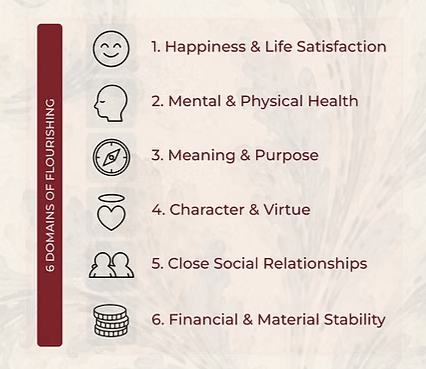
The Global Flourishing Study took a big-picture approach, studying six different domains of human flourishing.
Instead of zeroing in on one specific element of human thriving, the Global Flourishing Study’s research widened, studying the elements of happiness and life satisfaction; mental and physical health; character and virtue; close social relationships; meaning and purpose; and financial and material stability. Each of these “domains” were a factor in calculating a “Secure Flourishing Index,” a measure of a person’s flourishing relative to others.
The Global Flourishing Study (GFS) found that “material and economic conditions can strongly influence the extent to which flourishing is possible and sustainable,” and “questions of meaning and purpose are vital to understanding what makes life go well.” This has been studied extensively and is something many of us know intuitively. Financial security, material stability, and a purpose in life are all key to human flourishing. These needs are hugely important, and they’re something that a single activity, whether it’s playing Dungeons & Dragons (D&D), joining a soccer team, or acting in community theater, can barely touch. But that’s not the whole story.
Where D&D Fits In

A simple game of dice and stories has a lot of positive impacts in exactly the domains that the GFS studied.
On the other hand, D&D has been empirically shown to develop the GFS’s remaining four domains: virtue, mental health, happiness, and close social relationships. While we’re not operating under the delusion that this enormous study was created just to show you how neat Dungeons & Dragons is, we were amazed at how closely D&D’s benefits correlated to those that the Global Flourishing Study researched. But before we dive into the research, let’s lay the groundwork. What exactly is D&D? Well, it’s a bit of a mashup between board games and video games. Like board games, there’s a board with squares and little pieces to represent each of the players’ characters, and there are values to represent the characters' resources, like Hit Points or Spell Slots. Like many video games, each player controls a character and uses that character’s special abilities to overcome challenges, complete quests, and save the day. But unlike many board or video games, in D&D, the players are all working together, using each of their unique strengths to complete their missions as a team. The characters, challenges, and world are all created by a player called the Game Master, who uses the rules of the game and the roll of a dice to decide how the player’s actions work out. Believe it or not, this simple concept has huge benefits for its players, especially young people. As a group of therapists and educators who work with young people, we have seen the impact that D&D has on young people, and we were eyeing the results of the GFS for insights into what helps them flourish.
What Helps Young People Flourish
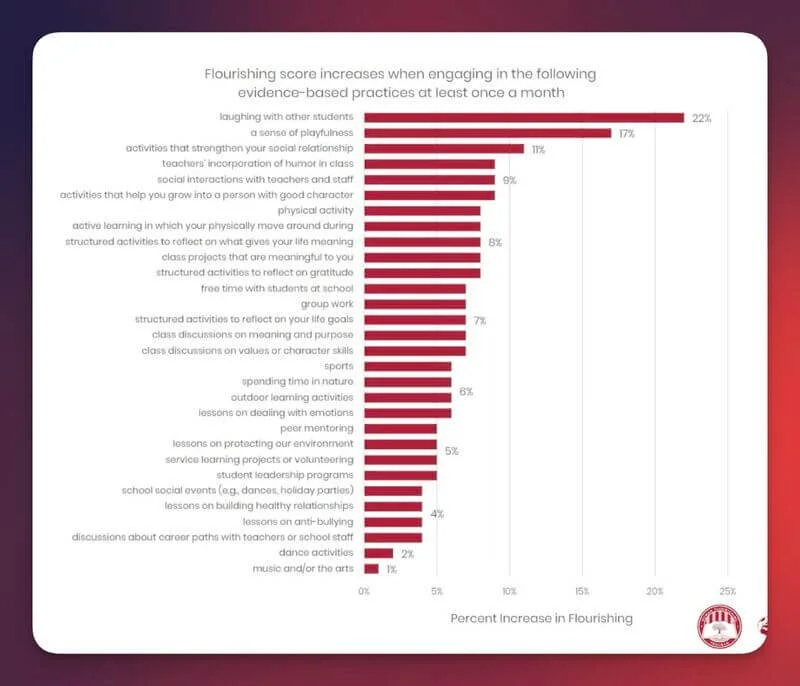
The Flourishing Schools Project broke down the impact of specific activities on students’ flourishing scores.
The study confirmed what we suspected: young adults, particularly in the United States, are not doing well. The New York Times’ analysis of the GFS stated that “on average, young adults between the ages of 18 and 29 were struggling — not only with happiness, but also with their physical and mental health, their perceptions of their own character, finding meaning in life, the quality of their relationships and their financial security.” This is the first time in history that young people have reported lower wellbeing than older people. According to the National Institute for Play, “This is not a small or ambiguous shift. The expected pattern that wellbeing rises with age and experience has inverted for the current generation of young people. They are starting lower and, in many cases, not catching up.”
But the GFS didn’t just report the overall low levels of flourishing for young people. It also conducted a sub-study, the Flourishing Schools Project (FSP), to find what activities helped those levels to rise. They tested activities from time in nature to physical activities to the arts, then measured how much students’ flourishing scores increased when they engaged in each of these activities. As we noted in our article about D&D and empathy, “Kids don’t [grow] through sitting quietly and listening or reading like adults do – they [grow] through playing!” This was abundantly true in the FSP’s data: “a sense of playfulness” increased flourishing scores more than “lessons on dealing with emotions,” “lessons on building healthy relationships,” and “discussions about career panthers with teachers or school staff” combined! And the study’s top three most effective practices for increasing flourishing? “Laughing with other students,” “a sense of playfulness,” and “activities that strengthen your social relationship.” Put simply: playing with other students.
Dungeons & Dragons has all this in spades. We can’t count the number of times in one of our 90-minute sessions that the group erupts into laughter over a goofy in-game encounter, a shared joke, or even a silly interpretation of a dice roll. The imagination, creativity, and fun in each session brings a deep sense of playfulness that leaves players (and Dungeon Masters) smiling and laughing even after the session ends. And for young people, seeing the same group of friends consistently each week, having time to chat before the game, playing together, and teaming up on a shared quest builds meaningful friendships (especially among autistic kids, ADHD kids, and anxious kids).
The game also incorporates other elements that made the FSP’s list. The necessity of a Dungeon Master often brings “social interactions with teachers and staff,” the game itself is one of several “activities that help you grow into a person with good character” (more on that later), and the whole premise of D&D is essentially one big “class project” with lots of “group work.” Though we admit we’re a tad biased, this list seems like a giant Harvard-shaped stamp of approval on the positive impact Dungeons & Dragons can have on young people.
Happiness and Mental Health
Wellness and happiness were two of the Global Flourishing Study’s six domains of flourishing.
After we looked through the Flourishing Schools Project, we were curious about the rest of the Global Flourishing Study and where Dungeons & Dragons might fit in, especially in those four “domains.” Two of them went hand in hand: happiness and wellness. And while it feels a little obvious to say, D&D makes people happy! Instead of gaining the most victory points or the highest score, the goal of the game is simply to tell a good story and have fun doing it. And while we need to dig a little deeper to show it, D&D has mental-health benefits, too. Research has shown that the game can help people with social anxiety feel more confident, build empathy, regulate emotions, and even guide players through mental-health recovery. It also has specific benefits for those dealing with anxiety and depression, which are two of the most common mental-health issues in young people.
Because the GFS studies participants of all ages, they were able to see the impact that this happiness and mental wellness in childhood can have on a person's adulthood, observing that “reporting excellent health during childhood is one of the most powerful and consistent predictors of feeling hopeful as an adult across many different nations” and “positive childhood experiences, such as having good relationships with parents, financial stability, good health, and frequent religious service attendance, are associated with a greater tendency to promote good in adulthood.” Turns out happy healthy children often become healthy happy adults.
Social Relationships and Virtue

Social relationships are hugely important for people of all ages, but especially young people.
But, as the data showed, many young people are struggling with mental health, and even more are unhappy. A huge part of this is their struggle for form genuine social connections years into the Surgeon-General-decreed loneliness epidemic. The Global Flourishing Study states (and we agree) that “relationships of love, friendship, family, and community are among the most important elements of a flourishing life,” so they studied “how social support, belonging, and connection shape well-being across the life course, and how loneliness, isolation, and social strain can undermine it.” These relationships and social support are one of the greatest benefits of Dungeons & Dragons, and, as the FSP found, one of the best ways to increase flourishing in youth. Because of the way the game works, it must be played with other people, often the same people over time. We’ve observed this, both as hobbyists playing D&D in our own lives, but also in our games with young people, three quarters of whom come back game after game to keep playing with their newfound friends. Research has shown this as well. A study at Tokyo Gakugei University found that after participating in a Dungeons-and-Dragons-style game, middle- and high-school students showed increased quality of life in the areas of “emotional well-being” and “friends” as well as “remarkable” improvement in social communication.
Another particularly interesting focus of the GFS was on morality and character. Their research “includes both philosophical and empirical work on the development and measurement of character, as well as on themes such as love, forgiveness, hope, optimism, gratitude, volunteering, charitable giving, delayed gratification, and moral character. Taken together, these studies show how virtue contributes to both personal well-being and the well-being of others.” These important elements, character, virtue, and morality, are also reinforced by Dungeons & Dragons. A study at the College of Charleston had participants play a game of Dungeons & Dragons containing moral dillemas. The study found that those who played D&D showed significant growth in moral development and even suggested that D&D can be used as a “moral training ground” for young people due to its ability to encourage debate, collaboration, and negotiation with your fellow players. The researchers note that this kind of roleplay can be especially helpful for teens and young adults, who are learning to appreciate shades of gray when it comes to what makes a person a “hero” or “villain.'“
In Conclusion
Taken together, the Global Flourishing Study’s results paint a strong picture of the positive impact of Dungeons & Dragons on the ability of young people to flourish. The study is also longitudinal, meaning that they’ll continue to collect data on the same participants over time, giving us even more insights into human flourishing. We’re curious to hear what they find, particularly if they’re able to continue their research on student activities. In the meantime, however, we plan to keep offering Young Dragonslayers games! We run online games of Dungeons & Dragons for small, consistent groups of tween and teen players, matching players with similar ages, play style, and support needs. Our crew of experienced Dungeon Masters come from helping professions from therapy to nursing to teaching, and they know what makes young people tick. If you know a young person who might be interested in playing with us, join the waitlist below!