Hank Green’s ADHD Diagnosis Shows ADHD Teens They Can Thrive
Pelican fanatic and top-tier TikToker Hank Green is a powerhouse. He’s crafted a book series, a #1 app, two merch companies, a TikTok presence, an educational video nonprofit, an annual charity event, a popular online-video convention, a hit podcast for teens, and more. Hank Green also has ADHD. While going through items from his childhood, he found an old diagnosis that he shared in a video on his personal channel (My Childhood Learning Disability). In the video, he reflects on how he's been able to thrive with ADHD, his pride in who he is and how far he’s come, and the support that in his childhood that helped him get there. We work with a lot of teens with ADHD and autism, and we haven’t been able to stop thinking about Hank’s video since it came out. His career is a brilliant example of a boy with ADHD getting support, growing up, and doing amazing things, and it exemplifies some important truths about ADHD and the people who have it.
Note: Unfortunately for us, we did not have the privilege of interviewing Hank for this piece; all quotes are taken from his videos, as noted. Hank, if you’re reading this and want to talk to us about D&D and supporting nerdy neurodivergent teenagers, email hello@youngdragonslayers.com.
Does Hank Green Have ADHD?
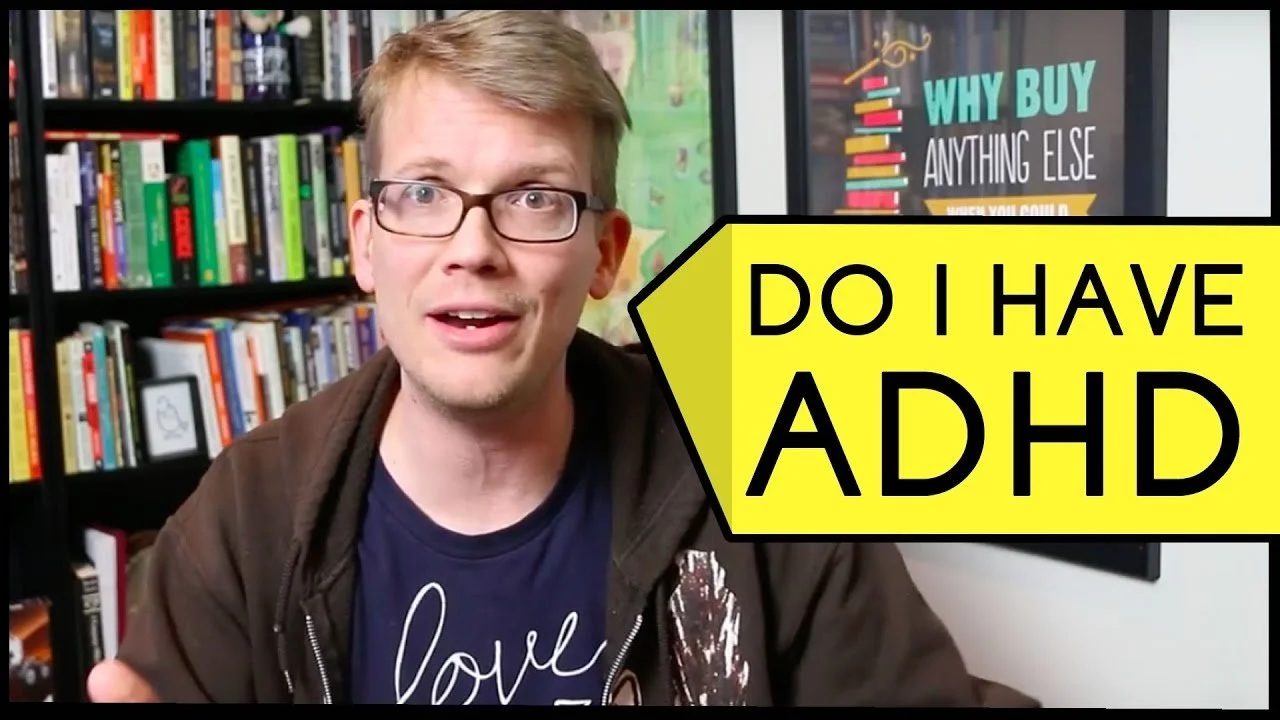
Hank Green publicly speculated on his ADHD status in a vlogbrothers video back in 2017 (Do I Have ADHD?)
“I’ve gone through my entire life, and I’ve been asked this many times,” said Hank, “People have been like ‘Hank, do you have ADHD? You seem like you have ADHD.’ and I’m like ‘I don’t know what I’ve got. I was never diagnosed with ADHD. But whatever I’ve got, I’ve learned to live with it and at this point I like it.’ Well, that was a lie. Because here, we have my ADHD diagnosis!” In a recent hankschannel video (My Childhood Learning Disability), Hank Green shared that in the 1985-1986 school year, his seven-year-old self was diagnosed with Attention-Deficit Disorder With Hyperactivity, what would now be considered Attention-Deficit/Hyperactivity Disorder or ADHD.* Hank looked back at the referral from his school, where his teacher reported “Hank is disorganized, has difficulty attending in class, and is often distracted,” and noted his “chronic history of physical restlessness, difficulty focusing attention, and lack of organizational skills.” We see this all the time: a passionate but distracted child with big ambitions and struggles to focus, keep still, and stay organized. “What’s that but just ADHD?” quips Hank.
* He was also diagnosed with Sensory Integration Dysfunction, which, as he notes, no longer exists, but would likely have been rolled into either ADHD or ASD.
Coping With ADHD As A Teen

Hank’s philosophy on disorders is clear in his response to his Delayed Sleep Phase Disorder (My Rare “Disorder”).
Hank may have “learned to live with it,” but that’s easier said than done. Folks with ADHD have to interface with parents and peers who didn’t understand them and often deal with frustration and loneliness from a difficult time making friends. “I still often hurt people’s feelings or annoy them by going somewhere else in my head when people that I care about are talking to me,” said Hank in an earlier video reflecting on his symptoms (Do I Have ADHD?), “I’m often late for stuff, which makes people think I don’t care about them, and sometimes I have very difficult-to-control flashes of rage in grocery lines…and when I am forced to disengage from my focus.”
The ADHD tweens and teens we see also struggle in a school system that wasn’t built with their needs in mind. “Sometimes I feel like the world is built for the average person, and none of us are average,” said Hank (My Childhood Learning Disability). He referred back to an example from a previous vlogbrothers video (My Rare “Disorder”) of his Delayed Sleep Phase Disorder (DSPD), a condition where a person’s natural bedtime (and thus, wakeup time) is later than the societal norm. In the video, he shared that this disorder was “a significant challenge to social and academic life,” during his secondary-school years, when he had to wake up early for school. “DSPD became a disorder because I was inside of a cultural optimization that could not allow for my natural variation,” said Hank. As time went on, Hank had a flexible class schedule in college and, subsequently, flexible work schedule as a blogger and YouTuber, which meant he could sleep at his body’s natural time and work during ideal hours. “I had the same sleep phase,” noted Hank, “But I no longer had a disorder, because the sleep phase was not causing me problems.” But now, he has a disorder again. Why? He had a child who has to wake up early for school! “Nothing about me changed, “ said Hank, “The thing that changed was the world around me, and that affected whether or not I had a disorder, which is very weird to me.”

Hank Green holding his ADHD diagnosis in a recent hankschannel video (My Childhood Learning Disability)
Hank feels the same way about ADHD. “There’s no doubt in my mind that ADHD is not a disorder except that the world is not well suited to people who have it,” said Hank (My Childhood Learning Disability) “I am lucky that I have found a way to be a professional in the world where it gives me advantages rather than holds me back.” If you are or you know someone with ADHD, know that there’s nothing “wrong” with them; they were just born in a world that wasn’t made for them, a world that expects them to sit still in a classroom and absorb knowledge from a lecture. And coping with that is hard work. Hank noted that, for himself, his strategy has been a combination of “making my world more me-shaped,” (creating his own business where his employees help carry the load of administrative tasks, pursuing ventures that utilize his hyperactive mind, and building relationships, professional and personal, with people who understand the way his brain works) and “[making] myself more world-shaped,” (making commitments to others to ensure he follows up, building systems to aid his executive functioning, and learning to channel his energy in productive ways).
Hanks Green’s ADHD App for Focus
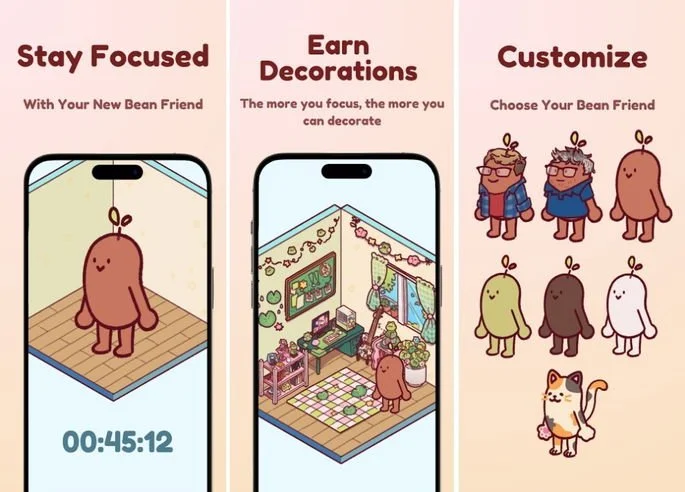
Hank Green’s ADHD focus app features a customizable bean (including “Hank Bean,” top left) for users to care for through deliberately setting down their phones.
Through, optimizing the world around him, working on himself, and, as he notes, getting lucky, Hank Green has been able to do some pretty amazing things in his career. One of them is Focus Friend, a productivity app in which users set countdown clocks in their phone to give a little animated bean time to work on their knitting. It has become both wildly successful and wildly effective, due, in part, to Hank’s familiarity with the focus issues. He put some of his most effective strategies into the app, from having an external counter to making an obligation to another being, even a virtual one. “[Focus Friend] is out there making the world more me-shaped for me,” said Hank.
This isn’t the only example of Hank Green’s ADHD being an asset rather than a liability. In fact, one could argue that his ADHD is a big part of why he’s been able to create as many things as he has. As we note in our post about ADHD and Dungeons & Dragons, ADHD folks have a bit of a superpower when it comes to new ideas, starting projects, and seeing new and creative ways things could be done. That’s certainly been true in Hank’s creative and professional career — his creative proliferation has become a bit of an in-joke for fans; there’s a web site entitled Days Since Hank Green Last Started A New Thing (10, as of this writing) that resets with stunning regularity. In fact, professional brother and Dr. Pepper enthusiast John Green made a vlogbrothers video (Hank Green, from A to Z) in which he finds a Hank-Green project for nearly every letter of the alphabet. “You’ve never created something that started with a Z!” exclaimed John, “You have every other letter covered, but you do not have a Z. In short, Hank, your next project better start with a dang Z. And if I know you, Hank, it will, and it will be soon.” In true Hank form, he responded with own vlogbrothers video (The Economics of a YouTube White Noise Video) just three days later announcing a new project (Zonderia, a white-noise YouTube channel raising money for charity). To quote Hank, “What’s that but just ADHD?” (My Childhood Learning Disability)
How Can I Help My ADHD Teenager Without Medication

Many parents are hoping to help a teenager successfully manag ADHD without medication, which is possible in some cases (including Hank Green’s)
Hank’s story has hope for ADHD teens and kids who feel like they’re struggling – and for the parents who struggle alongside them. As Hank looked through his evaluation, he noted that his parents gave him higher scores (i.e. more ADHD symptoms) than his teacher in nearly every category. This is a common pattern among ADHD children with healthy attachments to their parents; they are able to suppress, or “mask” their ADHD for a time, but they eventually express themselves, usually in the places they feel safest. This can be difficult, but it’s ultimately a good thing: a sign that their ADHD child feels safe around them.
Hank’s parents supported him with his ADHD symptoms, but they also had to step in to get Hank an occupational therapist and other support for many physical problems. In My Childhood Learning Disability, Hank shared these problems and noted that when he asked his parents why they never pursued medical help for his ADHD, they told him that his physical problems were their main concern. “I guess by the time I went off to middle and high school, I did not have as many of these attention problems and so never got assessed for ADHD again and never ended up being medicated for it. Instead, I just have systems for doing the things I have to do, and, of course, creating an entire world for myself in which it is not a problem to have ADHD,” said Hank.
We should note here that this is not the best choice for every ADHD child, but, for Hank, these other forms of support and flexibility were enough on their own. “It looks like the school system did a pretty good job of handling this,” said Hank , “It’s weird to see how worried my parents were about this, how much work we did, and how invisible it is to me now. I’m proud of little me. I’m especially grateful to my parents and my teachers. I’m proud of my mom for handling this and being proactive about it and doing the work to make sure that I was getting my assessments and that…my problems were being taken seriously.” This story is a message to ADHD teens: that getting through the difficulties of ADHD takes work, but it’s work that’s worthwhile, and work that can mean, one day, those difficulties feel solidly in the past. It’s also a message to parents of ADHD teens: advocating for your children, making sure they’re being taken seriously, and getting them the resources they need can make all the difference.
Tools for ADHD Teens And Their Parents
We’ve seen the ways that DND can help ADHD teens to thrive as their full selves.
What can ADHD teens and parents learn from Hank’s experience? First, ADHD, though it can be very difficult to deal with, isn’t a solely negative thing — remember, it’s only classified as a disorder because ADHD people live in a world that’s not built for them. But when they receive good support, learn to adapt, and can find or build spaces in the world that accept them for who they are, ADHD can become a superpower, capable of launching them into a fulfilling life with brilliant creative ventures that make the world a better place.
“I feel like I’ve spent a lot of my life making my world more me-shaped,” said Hank, “And I’ve also made myself more world-shaped. And I think there we’re all going to find a different balance of those things. But it’s really cool to see the work that my parents did, that my teachers did, that the occupational therapists did to try and make me more world-shaped, which I think is really valuable. And I think that I’m, to some extent, still at it. I don’t think that I’ve stopped figuring out how to exist in this strange situation that we all find ourselves in.” It’s all part of the process “I’m working with the brain that I got,” said Hank, “In addition to building a life where ADHD can be a useful trait rather than one that is a disordered trait, I also have, over the years, used lots of different tools.” One he mentions is covering up large paragraphs of texts to help him focus on the line he’s reading, either on paper or screen. “I’ve learned some of those habits from living inside of my own body, but I’ve learned others from people who have ADHD and are talking openly and honestly about it, and also people who work with people with attention disorders,” said Hank (Do I Have ADHD?). To this end, he recommends How to ADHD, a YouTube channel of evidence-based tools and information to empower ADHD brains.
Research has also found other tools to help teens with ADHD. Spending more time in nature has been shown to bring young people with ADHD more relaxation and focus. Quality sleep helps avoid severe ADHD symptoms, anxiety, depression, and the kinds of emotional problems that can make it more difficult to cope. Psychological and learning assessments from schools can also qualify ADHD students for a 504 or IEP plan, which helps those with learning differences or disabilities get the support they need at school, either through changes to the learning environment or through special education. But one of our favorite (and, arguably, one of the most fun) tools to help teens with ADHD are creative storytelling games like Dungeons & Dragons (which, we would be remiss not to mention, Hank Green also plays from time to time). These kinds of games help ADHD players practice skills like socialization, executive functioning, and emotional regulation, give enough structure to be helpful, and provide opportunities for the kind of creative expression we often see in ADHD teens and kids. “Figuring out how to live in your own mind and your own body is the task of your life. And there’s no reason to think that you have to take that on alone,” says Hank. Our games are filled with tween and teen players who have seen the benefits to their social skills, executive functioning, focus, and more, making friends as they embark on epic adventures and find their people. Learn more and sign up for our waitlist via the button below, or download Focus Friend to help make yourself just a little more world-shaped.