A Girls Guide to Dungeons and Dragons
At Young Dragonslayers, we run inclusive DND for girls, so we know a thing or two about the best way to get started as a girl playing DND.
We all know the stereotypes. D&D is male dominated. Female or nonbinary players will have to fight to be taken seriously or be bullied out of the group. And we won’t lie to you, there are definitely places where this is true. But there are plenty of queer people and girls playing D&D, and the hobby is changing for the better. Now, the world of Dungeons & Dragons is as inclusive as it’s ever been, and there are plenty of places to find safe D&D games for girls and nonbinary players. We’re a crew of professional Dungeon Masters from across the gender spectrum who have been in this hobby for years, and we pride ourselves in creating inclusive D&D for all genders (and pushing back against sexism in D&D spaces). Here’s what we at Young Dragonslayers have to share with any girls looking to play D&D.
Is D&D Male Dominated?
For those wondering if gender matters in DND character sheets - not anymore! The sexist character-creation rules are nowhere to be seen in the latest edition.
Despite the fact that Western roleplaying games were largely invented (and played) by women, the original Dungeons & Dragons game emerged from the Wisconsin wargaming scene, which was overwhelmingly male. This led to some wildly sexist attitudes within the early days of the hobby. Alongside some very colorful commentary we cannot conscionably repeat here, Gary Gygax, co-creator of D&D, proudly proclaimed himself a sexist, claimed women’s brains were not suited to gaming the ways men’s were, and wanted women to “stay away from wargaming in droves for all I care” Oof. Many of today’s D&D players are acutely aware of its history. “D&D was founded to appeal to nerdy men, and it borrows tropes and themes that can be harmful,” said Dungeon Master Sergio. For example, the first version of the game made female characters worse fighters than male characters, changed their “Charisma” score to a “Beauty” score, and gave them abilities like “Charm Men,” and “Seduction.” Gross! Fortunately, these sexist game rules have been long since eliminated, and the current edition of D&D explicitly allows players to express their character concept without limitations due to a character’s gender, race, or ability status.
Can Girls Play D&D?
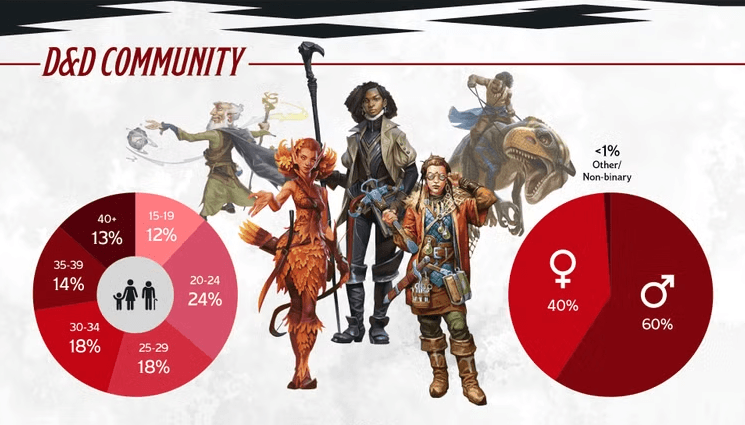
According to a 2021 infographic released by Dungeons & Dragons, 40% of D&D players are female and <1% are nonbinary.
As you can imagine, the culture many men created around early Dungeons & Dragons made it hard for women and girls to enjoy the game. Female players still have negative experiences today, even though they now make up 40% of D&D’s player base. Dungeon Master Maddy is one of them. “I used to get mansplained to all the time about what my character’s abilities should be and the spells I should take and what attacks to make. It was deeply frustrating, especially because the men at the table would only bother to do that with me, my nonconforming but fem-presenting friend, and the 15 year old boy who played with us. None of us needed advice, and we spoke up about it, but it never stopped.” she said. “We all eventually left the group because of that behavior.” That can be the experience of women and girls no matter what side of the DM screen they’re on, especially at the intersection of marginalized identities. Dungeon Master Liv, a queer woman of color, said she “used to get more pushback on my rulings and ‘GM authority’ at the table than I have seen male GMs receive.” While I’ve been able to avoid experiences like this myself, I (Dungeon Master Jaclyn) have heard so many of these kinds of stories from non-male D&D players.
Girls do play DND, and they also become Dungeon Masters - DMs like Maddy are living proof!
But it’s not always like this! Women and nonbinary people have fought for their own space throughout D&D’s history. “Things have changed, and I think now women, queer people, and more artsy nerds have carved out their own chunk of D&D to enjoy,” observed Sergio. In fact, Liv, who runs games at a local shop, now has a different experience. “We actually do have about 50/50 of masc and femme presenting people,” said Liv, “We are entirely run by female GMs and the guy who owns the cafe!” And even if a group starts out with mostly male players, when a game is inclusive, word gets around. My first group appeared to be 6 men and me (that’s what you get when you study physics), but the DM was inclusive and thoughtful, the not-so-great dudes all left, some women and genderqueer folks joined, and the DM eventually came out as nonbinary! “My long-running campaigns start out male-heavy and either balance out or the ratio flips somewhere down the line,” said Dungeon Master Joe; his first group started as 5 men and 2 women but became 5 men and 5 women, and his current group is now 2 men and 4 women. Maddy’s first tables were mostly men, but she’s kept in touch with and formed groups with “almost entirely women or gender non-conforming [players].” Our Young Dragonslayers games are like this, too. For example, of all the players in Sergio’s eight groups, there are 24 boys, 11 girls, and 10 nonbinary players – very different from what you’d expect from the stereotypes about D&D!
How Do Girls Play D&D?
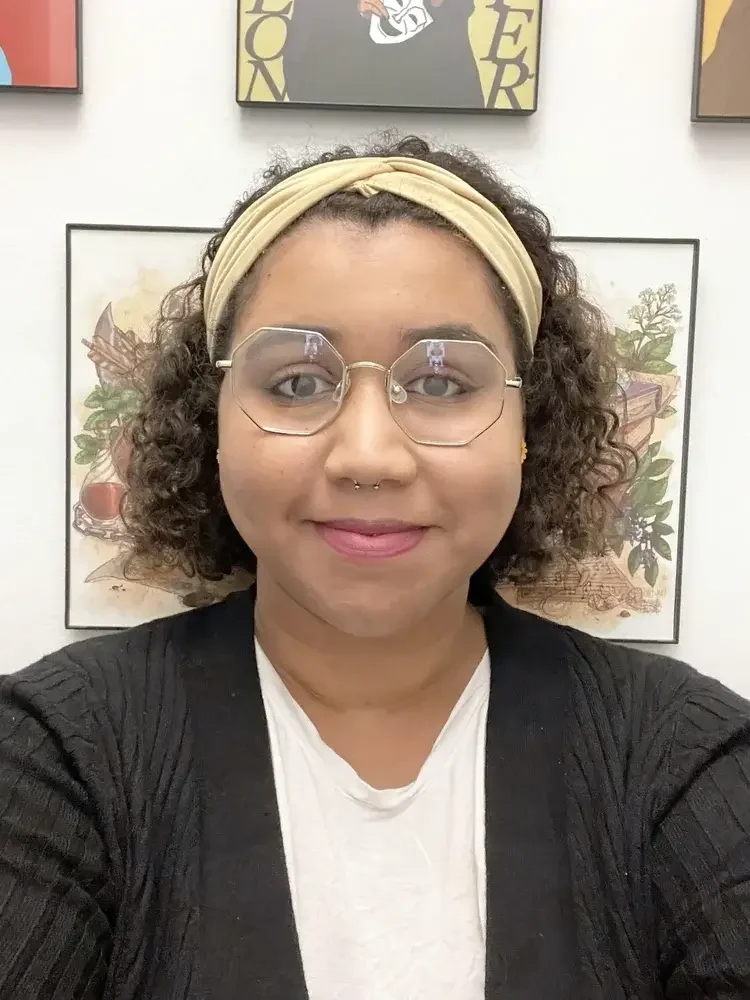
Dungeon Master Liv has seen girls playing DND in all kinds of ways.
No matter how the demographics break down, each gender and each player bring new strengths to the table. “I have tended to notice that more female-led games integrate safety tools and discussions around boundaries better,” said Liv, “I also have a more narrative focused gameplay style, while I have noticed more masculine GMs focus on the crunchier side of things and the mechanics.” She’s observed gendered dynamics in her players as well, “I find that my ‘murder hobos’ or ‘chaos gremlins’ (love to rip people to shreds and destroy families) tend to be more male, while my female players in these groups tend to move towards more role-play interactions,” she said. Sergio has seen a lot of “young boys who just want cool items and power, roleplay masters (transcends gender), and romancing roleplayers (typically the queer girls and non-binary folk).” In my games, I’ve seen chaos gremlins from every gender under the sun, but my players concerned with rules tend to be male, while my players concerned with relationships tend to be female, and my players concerned with their character’s backstory and identity tend to be nonbinary, genderfluid, and genderqueer. However, everybody approaches the game differently, and there’s no single determinant, gender or otherwise, of how someone likes to play. “While there are plenty of kids who adhere to more traditional gender dynamics there are also plenty of outliers. There are shy quiet boys, murder hobo girls, and everything in between!” said Sergio. The most important thing for inclusion in D&D games is making space for whatever identities, play styles, and support needs show up to the table.
Does Gender Matter In D&D?
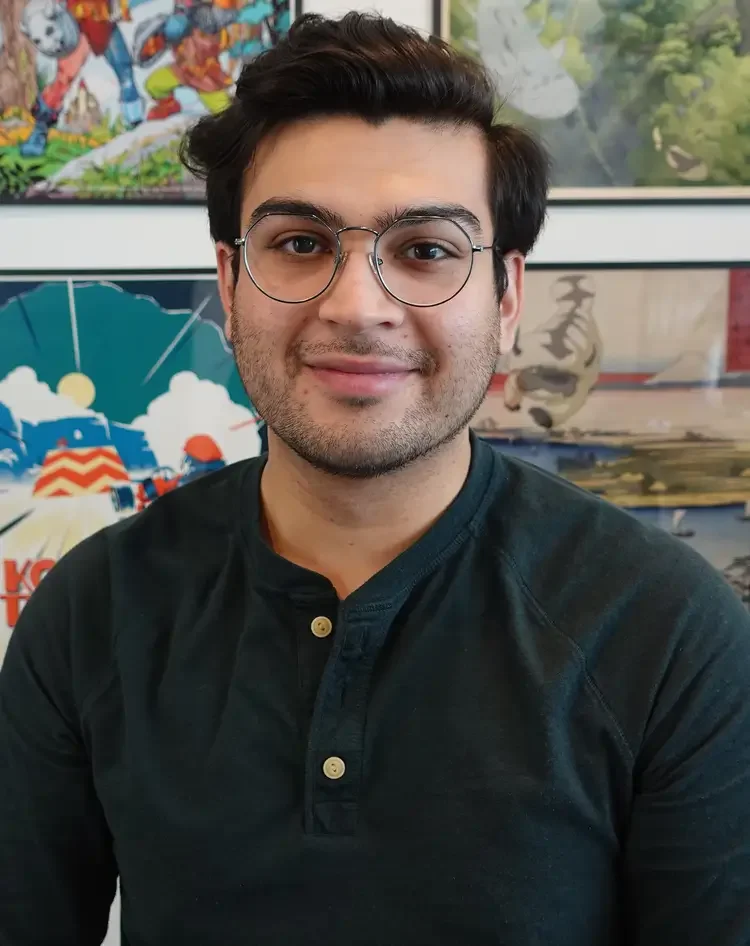
Many Dungeon Masters like Sergio make sure to run safe DND games for girls, boys, and nonbinary players to explore identity and have fun.
As Dungeon Masters, we’ve done a lot of thinking about how to make gaming tables inclusive and make sure nobody gets mistreated or feels like the odd one out. This means implementing structures like group guidelines, communication, and safety tools, but it also means letting each player engage with gender and identity in the game however they’d like. “The younger the kids I work with, the more flexible they seem in their willingness to try roleplaying characters with a different gender from themselves,” said Maddy, “It’s really fascinating!” She encourages those players who express interest in playing a gender that differs from her own and uses it as an opportunity to remind all players of the difference between character and player pronouns. I play with lots of queer and questioning players who have used the freedom of playing a character to experiment with putting on different gender expressions and identities in a safe space. “On their own, many of the kids explore their own identity through their characters,” said Sergio, “And I think they feel comfortable doing so because that is the environment that [Young Dragonslayers] strives for, one that is inclusive of exploration.”
No matter what choices their players make about their characters, Dungeon Masters can always bring a diverse cast of characters to their in-game worlds. “I try to include NPCs of different species and races a lot,” said Liv, “An ethnically diverse cast in TTRPG means a lot to me and I think that a lot of the people I play with are familiar with the monoculture of fantasy TTRPGs.” Maddy deliberately creates fictional worlds without gender norms. “Anyone of any gender or race/species has the same potential abilities as anyone else, and they can take on any role in that society,” said Maddy, who creates non-player characters of all genders taking all kinds of roles – including heroes and villains! Sergio does the same. “I am constantly trying to push gender norms and increase diversity,” he said, including “making a woman the emperor of the largest kingdom, giving female gnomes beards, creating non-binary characters, and including gay couples.” While many of his players don’t seem to notice, some are overjoyed to see these inclusions – which is exactly the point!
Inclusive Dungeons & Dragons for Girls
Girls can (and should!) play D&D, and now, more than ever, there are safe, fun spaces for them to do so. “I do think the D&D space is generally inclusive of women, and considerate about the portrayal of gender. However, you have to find the right space, both online and in-person. I am sure there are a lot of people out there who hate how diverse the D&D space is now,” said Sergio, “So if you roll up to a random D&D store that hosts groups, you might not enjoy the company, but if you do some research online, you might find a group.” If your research online has led you here, you’re in the right place. Our Dungeon Masters – Liv, Maddy, Sergio, myself, and many others – build inclusive spaces where tweens and teens of any gender, experience level, and play style, can be themselves (We even have all-girls and all-LGBTQIA groups for players who are hoping to connect with peers like them). And D&D is the perfect way to do that. Sergio puts it well, “In a game where you can take on new roles and identities, perform as grandly as you would like, and get to practice social interactions, it's the perfect medium to have fun.”