Inside a Young Dragonslayers Game: A Behind-the-Scenes Look at One Session

If you’ve ever wondered what happens in an online DND session for kids, this is the article for you!
At Young Dragonslayers, we run safe, inclusive, and fun online games of Dungeons & Dragons for tweens and teens. It’s basically the coolest job in the world. But when we tell people about what we do, they have a lot of questions. How does online D&D work? What kind of preparation do you have to do for kids? What even happens in an online D&D session for kids? Is it safe for kids to play D&D online? So we decided to give you a peek behind the Game Master screen and give you a play-by-play of a single session, showing you all the details you might want to know.
How To Start Online D&D For Kids That Lasts
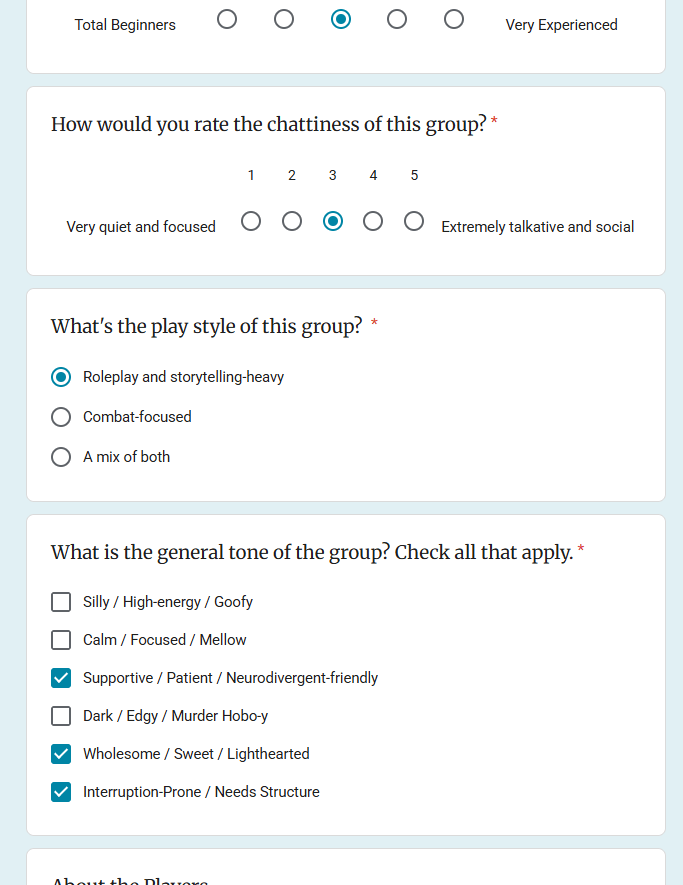
Creating a safe space for kids to play DND starts with finding a good fit for a group, which Young Dragonslayers does using feedback forms like this one.
Hi! I’m Game Master Jaclyn, and I’m here to take you through an online D&D session I ran just this week. This session is from my teen group that’s been meeting on Monday nights for the past two years. (Player Manager Katie met with these players and their parents, heard about the players’ personality, play style, and support needs, and placed them in this group. At the end of each quarter, I’ve updated her with the group dynamic and play style so that she can add in any new players for the next quarter). This week’s game is session 7 out of 10 for the quarter, and it’s with 6 players; 2 of them have been around since the beginning, and all of them are returning from the previous quarter. That means they all know each other and get along well – so well, in fact, that before I open the session, the server is already lit up with book discussions, video-game recommendations, ideas and art for future D&D characters, and a selected assortment of memes.
Can Kids Play D&D On Discord?
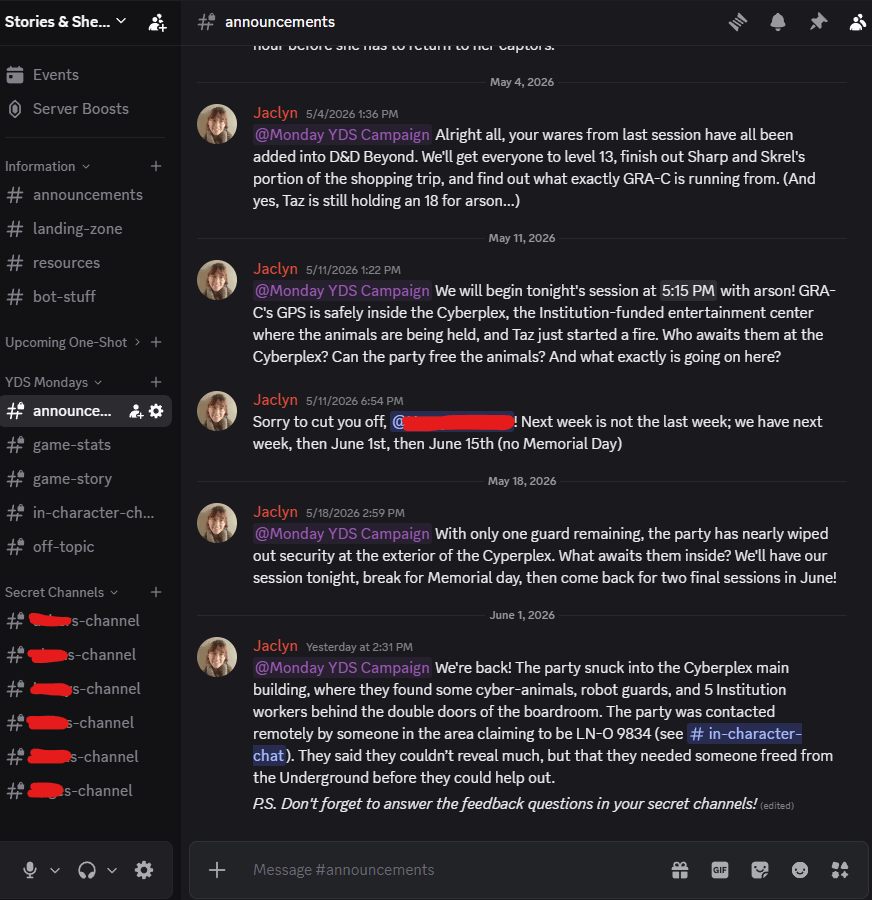
We use tools like Discord in our online DND for teens - here’s the server I use for my games!
My group’s server is on Discord, a free app that’s a gamer’s mashup of Zoom and Slack. Because it’s a third-party app that only allows users 13 and up, I only use it for my teen games (and only with consent from both players and their parents — for more on the pros and cons of Discord, check out Katie’s article)! On this server, which I’ve playfully titled “Stories & Shenanigans,” I can choose whom to let in; each quarter, I generate a new link that only goes out to my Young Dragonslayers players and expires after 6 uses. Once players have entered the server and I’ve confirmed their identities with Katie, I give players access permissions for this specific group, which lets them interact in all of the appropriate text channels and join the video calls. When the quarter is over, players’ permissions are removed, so no former players are lurking in the server when new ones arrive.
Before I start up the call, I open up my notes, digital editions of the D&D books, the players’ character sheets, and the virtual tabletop (more on that later). Then I peruse the various channels. “Announcements” gave the players an update on tonight’s session, “Game Stats” has some D&D statblocks from last session, “Game Story” has lively discussion and cool art for future characters, “In-Character Chat” has some interactions from last session, and “Off Topic” has the aforementioned memes. Then we have what I’ve termed the “secret channels,” each of which can only be accessed by a single player, myself, Katie, and the substitute Game Masters who have joined the server. In their secret channel, one player has shared some ideas for their backstory that they want to incorporate into the game. Another player has asked for help building their character sheet for the next quarter.
But I’m looking for something specific; last session, I sent a message to each of the players asking them to share one thing they’ve enjoyed and one thing they’ve found frustrating about the campaign so far, so I read through their responses before I open up the call. As everyone joins, they say hi and chat about their weeks (two recent video games dominate the discussion). I transition into the game by letting them know I’ve read through their feedback and will be implementing a new style of turn-taking in response. I check in with them to see what they think, and they’re all in favor. We’re ready to play!
What Happens In An Online D&D Session for Teens?
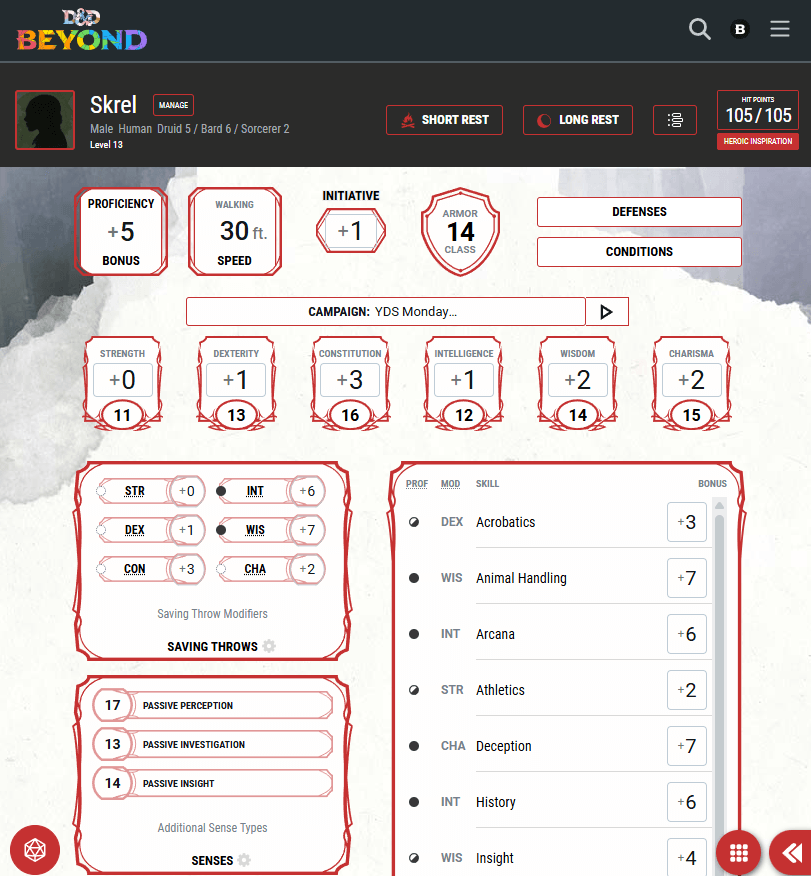
One of the digital character sheets my players use. They refer to this to see what to add to their dice rolls, what kinds of abilities they have, and what items they’ve accumulated over their adventures.
This is when the fun starts. First, I give the players a recap of the previous session. Last time, the party broke into the Cyberplex, a high-tech entertainment center in a sci-fi future, and defeated the exterior guards. As they healed from the battle, they talked to GRA-C 0372, a cybernetic bird whom they had tracked back to the Cyberplex. “Grace,” as they nicknamed her, told them that the Cyberplex held uncompassionate scientists experimenting with cybernetic implants on animals. She said that these animals were there to entertain the guests of the Cyberplex and that they were programmed with a Governor Module that would punish them if they disobeyed a direct order or left the Cyberplex premises. When the party asked how Grace was able to leave, she explained that her GPS chip had been temporarily disabled by a mysterious hacker going by LN-O 9834. Before the session ended, the party snuck into the Cyberplex, received transmissions from LN-O 9834 asking them to free someone from “The Underground” and promised their help in return.
Once the players are caught up on what’s going on in-game, they snap back to the present, where they have to deal with the (many) robot guards inside the Cyberplex main building. As they discuss, two plans emerge. Plan A is to have the pugilist pick up the rogue and throw him at a robot. Plan B is to have the bard hack one robot to attack the others. The players vote on what to do — while Plan B wins out, they decide that Plan A can still happen in the resulting chaos. I tell the bard that they have to make two rolls to hack the robot: one to approach it without being flagged as an intruder, and one to do the actual rewiring. They proposes that he first uses his skeletal form and Greek-Fire innards to intimidate the robot into freezing up. Their Intimidation roll is a 20 on a 20-sided die, also known as a “natural 20” (this is the best result in D&D, and in my games, I rule that something awesome happens). The player proposes that their character is so scary that he rewires the robot just by glaring at it — I think that’s a great interpretation, and I agree that it happens: the robot goes haywire and starts attacking. As the other robots approach to restrain it, the pugilist picks up the rogue and throws him at the robot blocking the stairs to the underground. There’s no rule for how to resolve this in D&D, but part of the fun is figuring out how to make ridiculous ideas work. I decide to have the pugilist’s player roll a Strength check to successfully throw the rogue and the rogue’s player make an Acrobatics check to try and land without getting hurt. Each of them rolls a 6-sided die for damage, and the robot is knocked to the ground. The party decides to leave the chaos behind, run past the fallen robot, and go down into the underground.
How Does Online D&D For Teens Work?
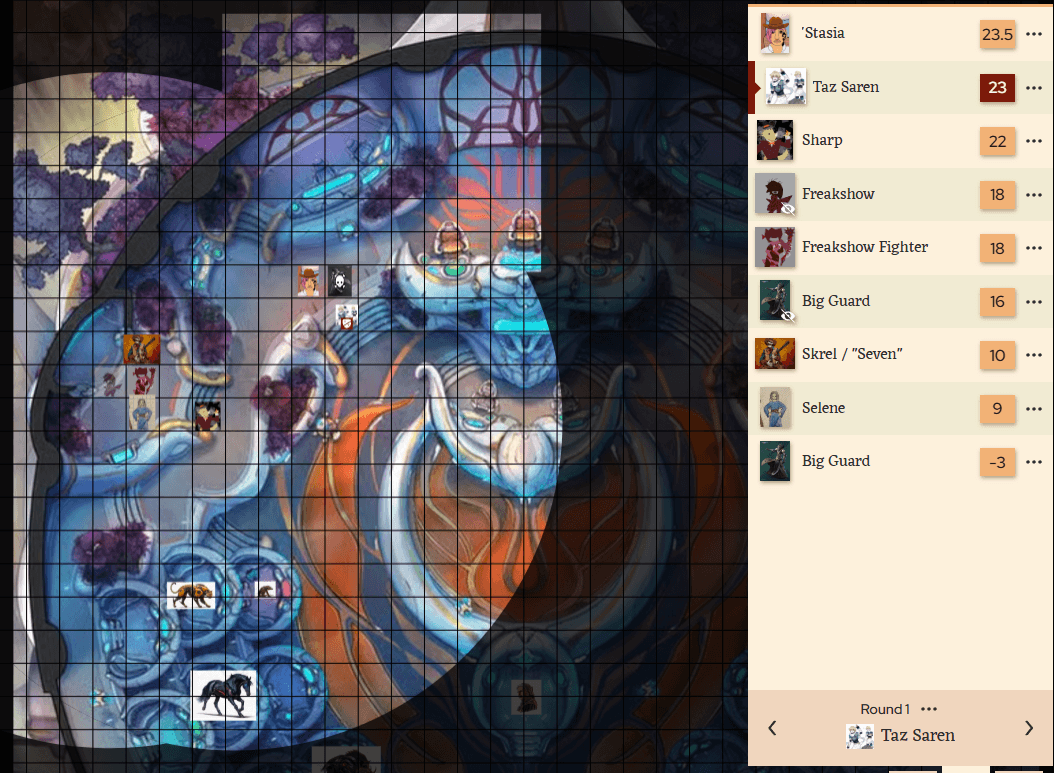
Online DND for kids and teens is made much easier with a virtual tabletop like this one! Here you can see the initiative order and the mysterious underground — the players only see where the light can reach.
As they descend, I go to the virtual table top: the internet’s answer to maps and minifigures on a table. Each of the players’ characters has a picture representing them, along with the robot guards and the cyber-animals. I switch from the map of the first floor with the robot guards to the map of the underground. It’s dark down there, and there's a good reason. When the rogue was introduced, his player had alluded to one deep fear that he had always kept hidden. The player used the secret channels to tell me that the character was afraid of the dark, a hilarious phobia for a rogue. I promised the player that it would come up in the campaign, and now is the time. As the characters delved into the depths (and at the rogue’s player’s request) I have all of them make an Insight check against the rogue’s Deception check. Nearly everyone succeeds. The party notices the rogue quaking in his boots and swiftly comes to his aid, offering encouraging words, hugs, and even a torch, lit by the bard’s own Greek Fire, and a spell that causes the rogue’s top hat to glow in the dark.
This light reveals a strange series of pods holding more cyber-animals and an advanced robot sentry who immediately notices the intruders. This is the part where I get to say the iconic line…“Roll for initiative!”. Every player makes an Initiative roll to decide in what order they, and the enemy combatants, take their turns, starting with the highest roll. The virtual table top has a nifty initiative tracker which keeps the order and tells players whose turn it is. This party in particular has a special component to their initiative. One player created a character that’s a sort of magical Frankenstein whose body is constantly morphing: gaining and losing features like a tail, wings, or claws. Every time it rolls initiative, it also rolls to decide what class it’s going to be. Last time, it was a sorcerer, but now, it’s a fighter. Like most of the party, the changeling’s art is created by its player, who has also created custom art for each class. They’ve already sent me the art in their secret channel for me to put on the virtual tabletop as they describe the transformation. For an excellent description and artwork, I grant the changeling Inspiration. (It’s a sort of meta-currency for doing something particularly cool that they can later spend to reroll a die.)
Then the battle commences. The cleric swoops in to defend the party with her sword, the pugilist follows up with a series of magically-empowered punches, and the rogue, deciding that their character is still too afraid to move, casts a long-distance spell to strike the robot with a bolt of lightning. This isn’t the most strategic choice, but it is very much what the character would do, so I give Inspiration to the rogue as well. The lightning bolt deals double damage to the electricity-powered robot, defeating it right before we reach the end of our 90-minute session. I let them know that we’ll start next session in the underground (naturally, there’s another robot hiding in the dark, but they don’t know that), share some scheduling updates, and give space for questions. They mostly chat about what they think is going to happen next and hype up their character’s actions, but there are a few game-rules questions that I help clear up. Then I bid everyone goodbye and end the call. Another session down!
Creating A Fun, Safe Place For Teens To Play D&D
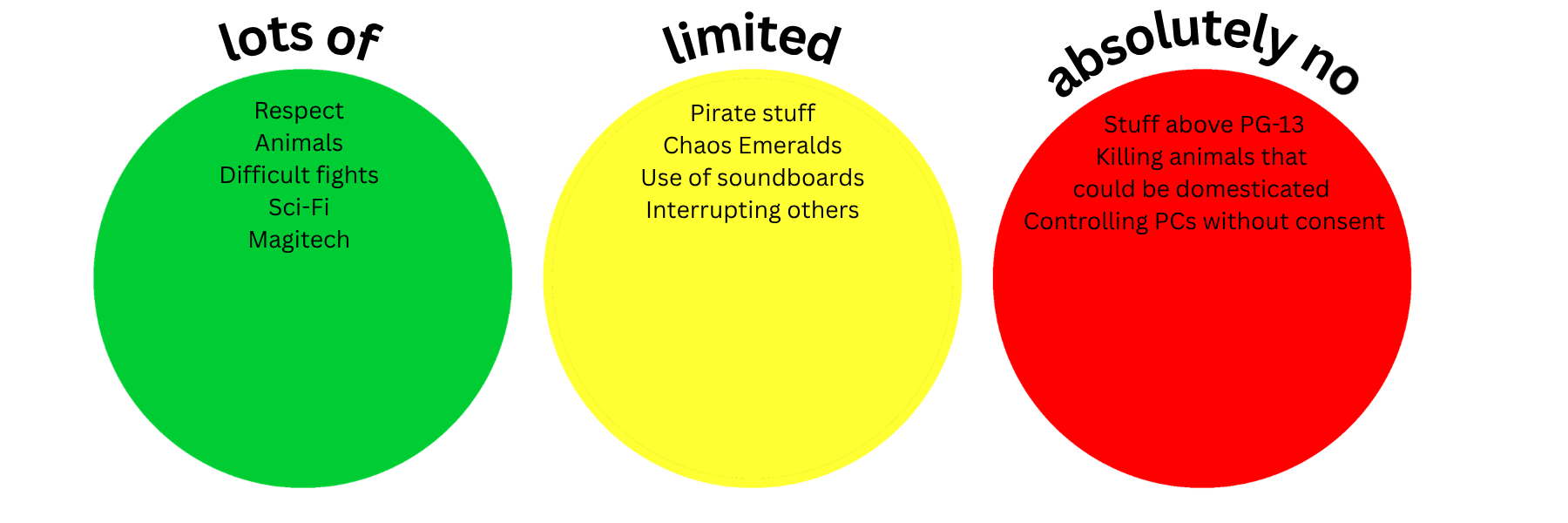
Safe spaces for teens to play DND start with setting boundaries and discussing needs. Here’s my teen group’s “Red, Yellow, Green,” tool we use to remember what we decided on together.
This makes it sounds like everything naturally went smoothly (and in many ways, it did – I have great players!), but this is never guaranteed in Dungeons & Dragons. A lot of it is due to the way Young Dragonslayers sets players up to succeed. During the first session of the quarter, Game Masters and players collaboratively build the guidelines for the group - what behavior is and isn’t acceptable, how particular game elements are treated, and how we handle things like late starts or absences. For example, I have a rule where any interaction between player characters has to be mutually consensual and resolved by the players. So when the pugilist’s player wanted to chuck the rogue at the robot, they checked in with the rogue’s player and they decided together how it would play out in character. Because this group is all returning players, they also got to decide what elements would be included; the difficult battles, presence of animals, sci-fi setting, and a few other elements all came from player requests.
We’ve found that giving young players agency, letting them make creative decisions, express their needs, and practice advocating for themselves with a supportive adult, makes for the most fun games – and for an activity that helps young people develop! If you like what you’ve heard about what we do here, join our waitlist. When the next quarter comes around, Katie will reach out to set up a meeting with you and your child and find the perfect group for them!