This Delicious in Dungeon D&D Module Is The Perfect One Shot
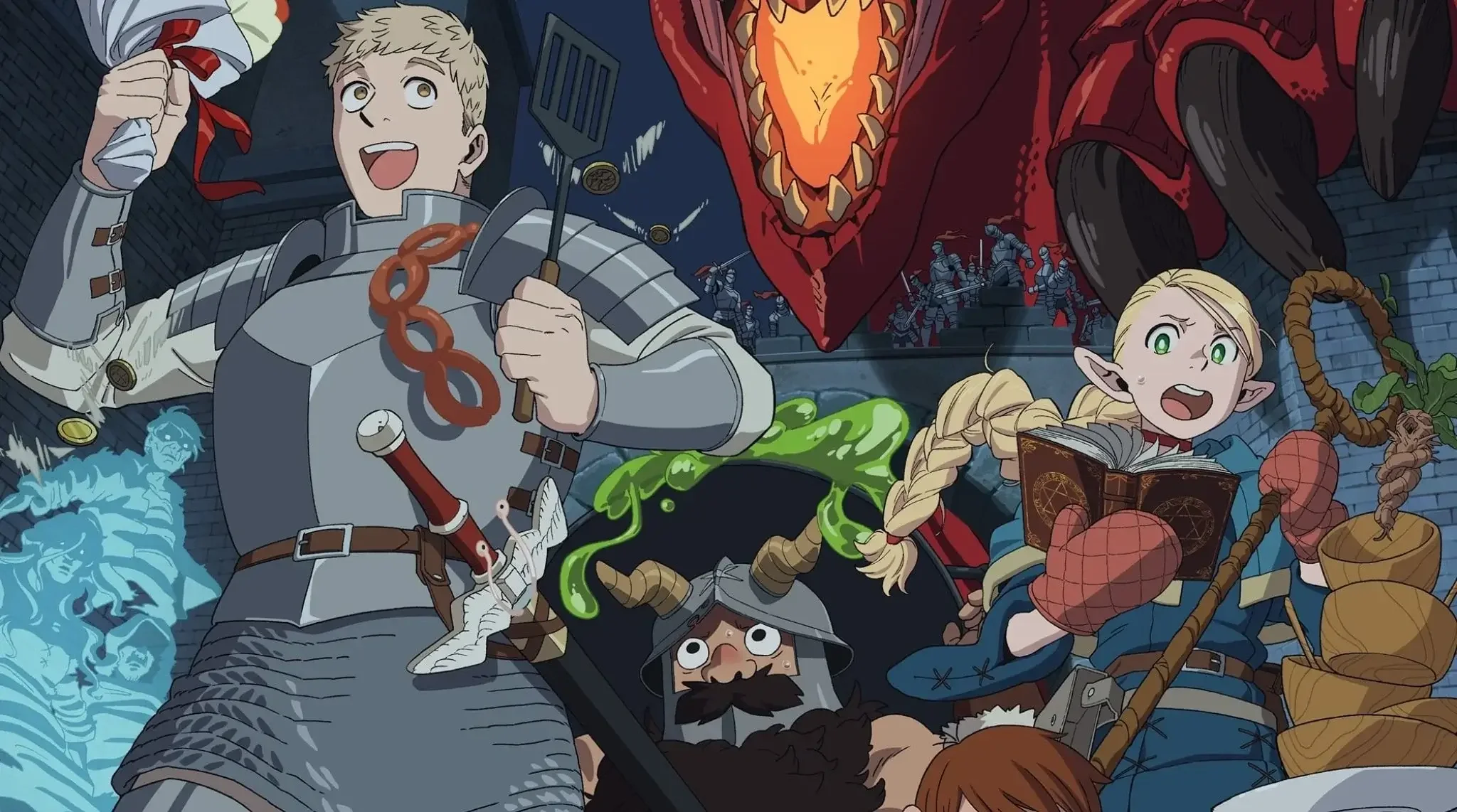
We created our own Delicious in Dungeon DND 5e adventure!
Delicious in Dungeon, also known by its original name, Dungeon Meshi, is essentially a Dungeons & Dragons game in anime form. The Delicious in Dungeon characters are all classic D&D builds, like Fighter, Cleric, and Rogue. And the show itself is literally a dungeon crawl: they fight monsters, find treasures, and survive the dungeon as they delve ever deeper. So when I got the chance to run a one-shot for the Young Dragonslayers holiday-break games, I decided that I would craft my own Delicious in Dungeon D&D homebrew for my players. I built a self-contained dungeon crawl with two goals in mind: collect ingredients and cook a delicious dish. My players and I had such a good time that I wanted to share it with you. I present to you: Delicious in Dungeons & Dragons!
The Delicious in Dungeon Characters’ D&D Classes

Picking the Delicious in Dungeon DND classes was easier for some characters than others.
One of the most important components of any Dungeons & Dragons game is the characters. They determine the build and abilities of the party, give opportunities for tie-ins to the game world, and, of course, are how the non-DM players interact with the game. For this Delicious in Dungeon D&D module, players can bring their own characters or play as the actual characters from Dungeon Meshi. Because each of them are inspired by an RPG staple, they’re pretty easy to create in Dungeons & Dragons!
Let’s start with the leader. For my Laios D&D character sheet, I gave him the Fighter class – pretty straightforward as classes go! To fit his role in the party, I also gave him the Inspiring Leader Feat, and to reflect his monster knowledge, I gave him Expertise in Nature. Because he becomes a magic user, I selected the Eldritch Knight subclass to give him a few spells.
My Marcille D&D build needed to be a magic user who could use spells to both attack and heal. So I made her a Cleric, making sure to pick out a mix of defensive and offensive spells. The Cleric of Light gets some especially powerful offensive spells, and it fits thematically, so the choice for a subclass was obvious.
Perhaps the easiest choice was the Chilchuck D&D class – with his talent for finding secret passageways, disarming traps, and picking locks, he’s clearly a Rogue. I gave him Expertise in Sleight of Hand and the Thief subclass to really highlight his very particular set of skills.
For my Delicious in Dungeon Senshi D&D class, I selected the Fighter and gave him a battleaxe. I narrowed it down further with the Champion subclass (no bells and whistles here) and, of course, gave him Proficiency in Cooking Utensils.
An Izutsumi D&D character class was harder to pin down. I was tempted to make a Rogue to reflect her stealth abilities, but she usually fights with her claws, not traditional fare like daggers. So I settled on a Monk, combatants who have honed their bodies to battle without weapons. For her subclass, I chose the Way of Shadows to reflect her stealth and agility.
Making A D&D Dungeon Meshi Homebrew Dungeon

A key component of a DND Dungeon Meshi module is finding the right monsters to battle!
Now that I had chosen the Delicious in Dungeon D&D classes, I needed to craft a dungeon. Dice Grimorium created a small, self-contained dungeon map that was perfect for my purposes. It had one large room, two medium-size rooms, and two small rooms. I selected a mix of animals, fungi, and plants that would challenge a level-5 party (without killing them) and make for a nice set of ingredients to choose from.
The opening medium room I set up as the cooking room. In the other medium room, I put a monster I called the Armored Taurus (this is based off D&D’s Gorgon, but instead of being a construct in the shape of a bull, it’s a flesh-and-blood creature with special glands that produce noxious gas — more on that later). The small rooms contained the vegetarian options: an underground crop of giant potatoes and a mushroom-covered floor protected by a Myconid Sovereign and two subjects. Finally, in the large room, I put a good old-fashioned Hydra. These all come together to give the players some interesting choices, but more on that after the main course!
Cooking Rules for A Delicious in Dungeon D&D Campaign
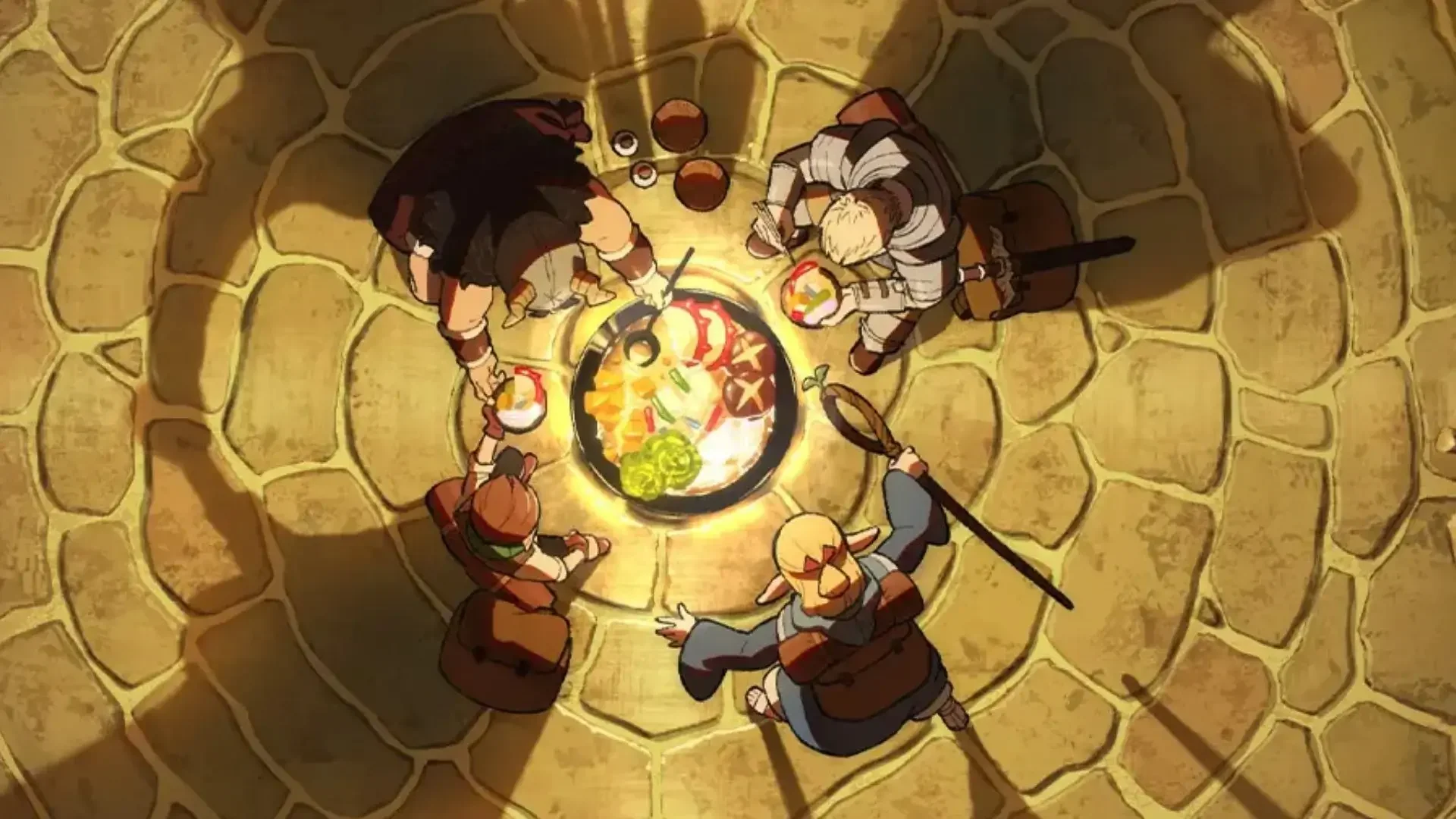
We really wanted to get cooking right for Dungeon Meshi DND.
Without a monster meal, a Dungeon Meshi D&D module is just a normal dungeon crawl. So I set about creating a system for cooking. First, I assigned serving sizes: the Armored Taurus was 3 servings, the Myconids were 1 each, the floor mushrooms were 4 servings, the potatoes were 3, and the hydra was a whopping 6 (more if the players engaged in strategic decapitation). When the players decide to go back to camp (or, like in mine, when there are 20-30 minutes left in the session), it’s time to cook.
The meal has four stats: Sustenance, Flavor, Texture, and Appearance. Before cooking begins, it has a score of 0 Sustenance and 5 in Flavor, Texture, and Appearance. Players roll initiative (or use their most recent initiative order) and proceed in turn order. On each player’s turn, they select one of the available servings and make a DC 12 check to prepare it. The nature of the check made is up to the Dungeon Master’s discretion, but here are some suggestions (many thanks to the RPG Stack Exchange). Remember, it’s more fun if the players come up with their own ideas, perhaps even making an argument for a specific check!
A Strength or Constitution check to chop up the Huge Hydra without breaking a sweat
A Dexterity (Sleight of Hand) check to perfectly chop up the Myconid meat and give it a good old-fashioned frying-pan flip
An Intelligence (Nature) check to safely remove the Armored Taurus’ volatile gas glands and get at the tender meat
A Wisdom (Cooking Utensils) check to intuit the proper seasoning and cooking time for the potatoes
A failed check forces the player to roll on the Failure Table, while a successful check allows the player to roll on the Success Table; if the roll is greater than 16, the player has Advantage on the Success Table roll. The meal stats are modified accordingly based on the result of the table roll. You can find the full tables and rules in the free PDF!
How to Run Our D&D Delicious in Dungeon Module
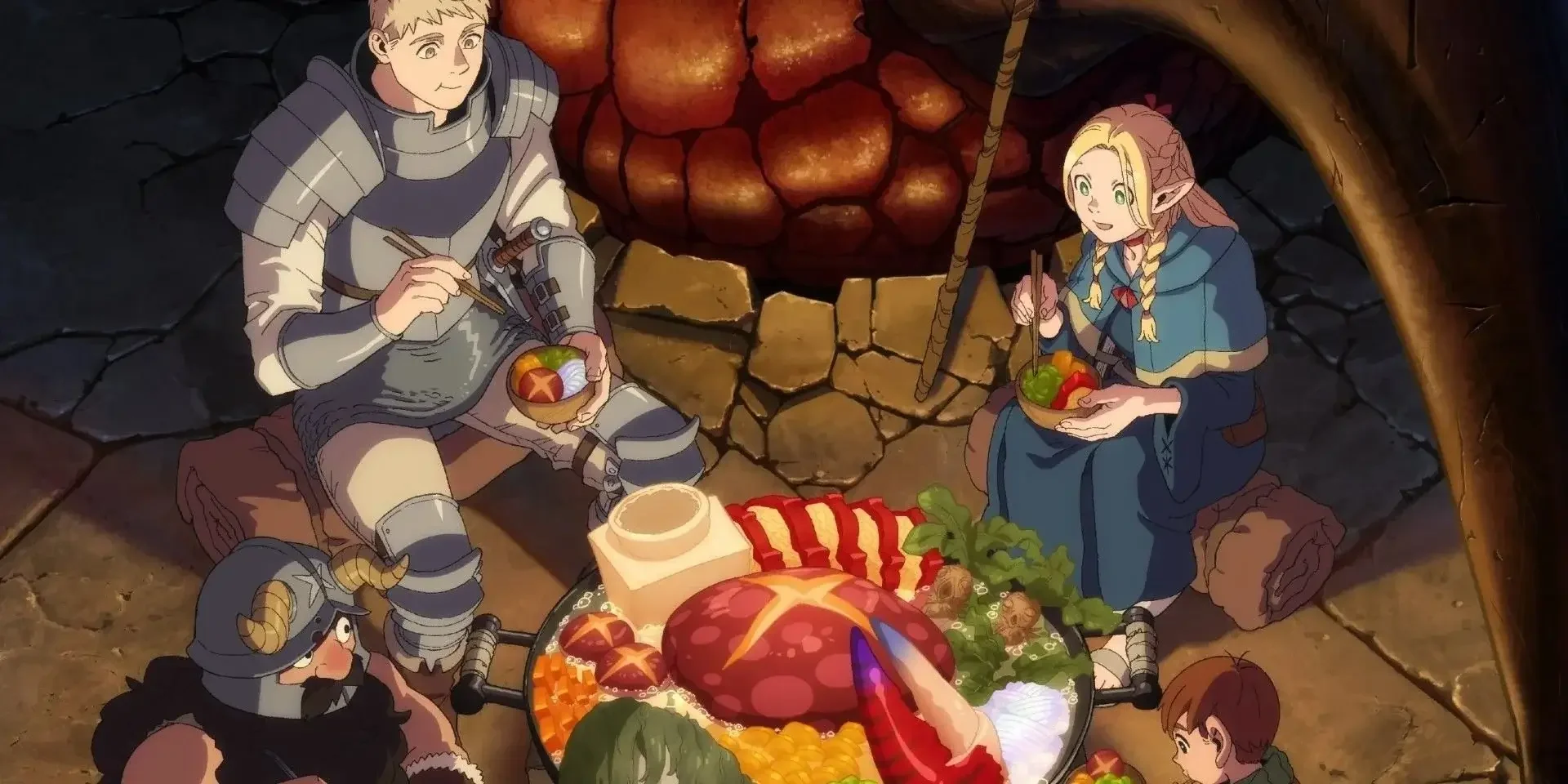
A DND Delicious in Dungeon campaign is all the more fun when there are strategic scenarios for players.
Now to bring it all together! If you’re the Dungeon Master for this Delicious in Dungeon Dungeons & Dragons module, here’s what you do. Start the players in the camp room. Explain to them the concept (they’re meant to collect ingredients and cook them so they can continue on in the dungeon), and show them the map. If you’re running a D&D Dungeon Meshi campaign, it’s more fun to slowly reveal the dungeon as you go, but if you’re running a Dungeon Meshi D&D one shot, I recommend coming up with a reason why they can see the dungeon ahead of time (I granted my players the Amulet of Seeing, an item I crafted that allows the wearer and up to 10 people of their choice within range to know the type, location, and challenge rating of all monsters and plants within 100 feet).
When the player characters get within 20 feet of a Myconid, they have to beat the Myconid in a contested Dexterity (Stealth) vs Wisdom (Perception) or be spotted. If a Myconid spots a player character, it immediately uses its Rapport Spores ability and begins to question the characters’ presence. If the PC’s succeed on an DC 12 check to convince the Myconids to share (such as an Wisdom (Animal Handling), a Charisma (Deception),, or a Charisma (Persuasion) check), the Myconids will allow the party to harvest the mushrooms growing in the room (DC 15 Intelligence (Nature) or Dexterity (Sleight of Hand) check). However, if the Myconids are met with violence, they won’t just stand there. They opening with their Pacifying Spores ability and attempting to flee to the room with the Hydra or, if that path is blocked, the room with the Armored Taurus.
If a player character gets within the sight line of the Armored Taurus, they must beat it in a contested Dexterity (Stealth) vs Wisdom (Perception) check or trigger combat. If there is a player character 20+ feet away from the Armored Taurus in a straight line, the Armored Taurus uses Trampling Charge. If that character is knocked prone, the Armored Taurus uses the Hooves bonus action.
The Hydra is sleeping, but one head is awake. If a player character gets within the sight line of the Hydra and is 25 feet away or fewer, they must beat the Hydra in a contested Dexterity (Stealth) vs Wisdom (Perception) check or wake up the Hydra and trigger combat. For each head that the Hydra grows as a result of its Multiple Heads trait, add one serving.
Play Your Own Dungeon Meshi D&D Adventure
If these ideas have you hungry for your own D&D Delicious in Dungeon campaign, we may have the games for you. We play Dungeons & Dragons online every single week! Our players are placed in groups based on their play style, schedule, and age (tween or teen). Then, professional Dungeon Masters (like me) craft custom D&D campaigns based on the players interests and play styles. We all love Dungeons & Dragons and are experienced working with young people; our goals are to run a well-crafted D&D adventure and create a safe, supportive space for our players. If you’d like to hear more about our games (or you’re curious to check out the full D&D Dungeon Meshi module), click below!